


While California's legal market is often associated with technology, private equity and entertainment, another practice area accounts for a particularly significant proportion of the state's lateral recruitment activity: labor and employment.
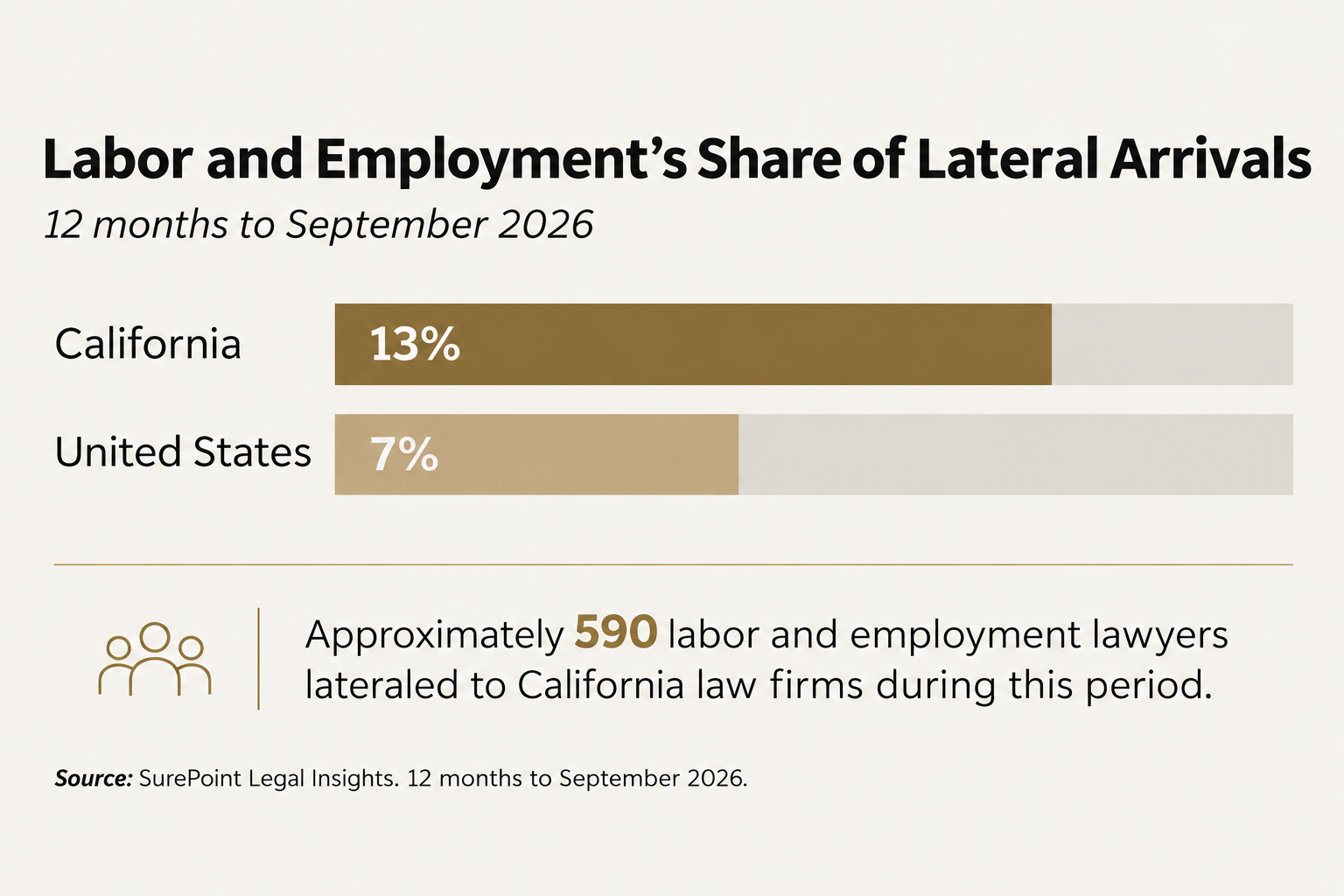
According to recent data provided by SurePoint Legal Insights, labor and employment accounted for 13% of lateral attorney arrivals at California law firms in the 12 months to September 2026, compared with 7% nationally.
With approximately 590 recorded lateral arrivals, labor and employment ranked second only to litigation in California during this period.
So, what makes California such a significant market for employment lawyers, and where are the opportunities for associates looking to make their next career move?
A Practice Area Outperforming the National Average
California's labor and employment practice accounted for a proportion of lateral arrivals almost twice the national benchmark.
The advertised recruitment market also reflects the strength of the practice. As of November 2026, California recorded approximately 110 open labor and employment attorney roles, after adjusting for vacancies advertised across multiple states.
This equates to 25 advertised positions per 1,000 practicing attorneys in the discipline, above the equivalent national rate.
While lateral recruitment figures and advertised vacancies measure different aspects of the market, both point towards a substantial market for employment law expertise in California.
A Complex and Continually Evolving Regulatory Landscape
One of the defining characteristics of California's employment law market is the complexity of its regulatory environment.
Employers operating in the state must navigate extensive requirements relating to minimum wages, overtime, employee classification, pay transparency, discrimination, workplace protections and meal and rest breaks.
California's Private Attorneys General Act (PAGA) adds another dimension to the market, allowing eligible employees to pursue civil penalties for certain Labor Code violations on behalf of the state.
Significant reforms introduced in 2024 changed aspects of the PAGA framework, including penalty calculations and opportunities for employers to remedy violations. These developments have created further considerations for businesses reviewing compliance procedures and managing litigation risk.
The regulatory landscape continues to evolve. California's statewide minimum wage increased to $16.90 per hour in January 2026 and is set to rise again to $17.40 in January 2027.
For law firms, this creates an environment in which employment litigation and proactive advisory work remain closely interconnected.
A Diverse Economy Creates Diverse Employment Law Work
California's economic diversity is another factor underpinning the breadth of its employment law market.
In San Francisco and Silicon Valley, technology companies face complex employment issues relating to workforce restructuring, employee mobility, compensation arrangements and the introduction of artificial intelligence into the workplace.
In Los Angeles, the entertainment, media and hospitality industries generate legal work involving employment contracts, collective bargaining, worker classification and workplace disputes.
Meanwhile, California's healthcare, biotechnology, logistics, retail and manufacturing sectors present their own distinct employment law challenges.
For associates, this diversity offers opportunities to develop specialist industry knowledge alongside technical employment law expertise, potentially building a more differentiated profile within the lateral recruitment market.
What Experience Are Law Firms Looking For?
Mid-level associates are particularly well positioned to explore the market.
Among California labor and employment vacancies specifying an experience range, 44% were centred on attorneys with four to six years of experience, while 40% targeted those with one to three years of experience. The remaining 16% were centred on attorneys with seven or more years of experience.
Experience that may strengthen an associate's lateral profile includes:
- Wage and hour litigation, including class and representative actions.
- PAGA litigation and California Labor Code compliance.
- Discrimination, harassment and wrongful termination disputes.
- Depositions, discovery, motion practice and trial preparation.
- Employment advisory work and internal workplace investigations.
- Employment-related due diligence in corporate transactions.
- Traditional labor law and collective bargaining experience.
Associates who can demonstrate both contentious and advisory capabilities may be particularly attractive to teams seeking versatile lawyers who can support clients across a range of employment matters.
What Does This Mean For Associates Considering a Move?
California presents an interesting proposition for labor and employment lawyers seeking exposure to sophisticated matters, commercially diverse clients and an evolving regulatory environment.
The state's legal market encompasses international law firms, national employment law specialists and established regional boutiques, offering different pathways for professional development.
For lawyers considering an interstate move, familiarity with California-specific legislation and local bar admission requirements will be important considerations. For those already practicing in the state, a lateral move may offer opportunities to deepen a specialism, diversify their client exposure or take on greater responsibility.
As 2027 approaches, understanding how individual firms are developing their employment practices will be key to identifying opportunities that align with longer-term career ambitions.


