RollOnFriday has released its Best Law Firms to Work At 2026 rankings, offering one of the clearest snapshots of lawyer sentiment across the UK legal market.
Based on anonymous survey responses, the rankings measure overall satisfaction across pay, hours, management, career development and culture. Firms are grouped into satisfaction bands ranging from “extremely satisfied” to “dissatisfied” — providing a useful lens on how lawyers actually experience life inside their firms.
This year’s results point to a more nuanced picture of lawyer satisfaction, where compensation remains important but sits alongside culture, workload and long-term sustainability.
The Top of the Table
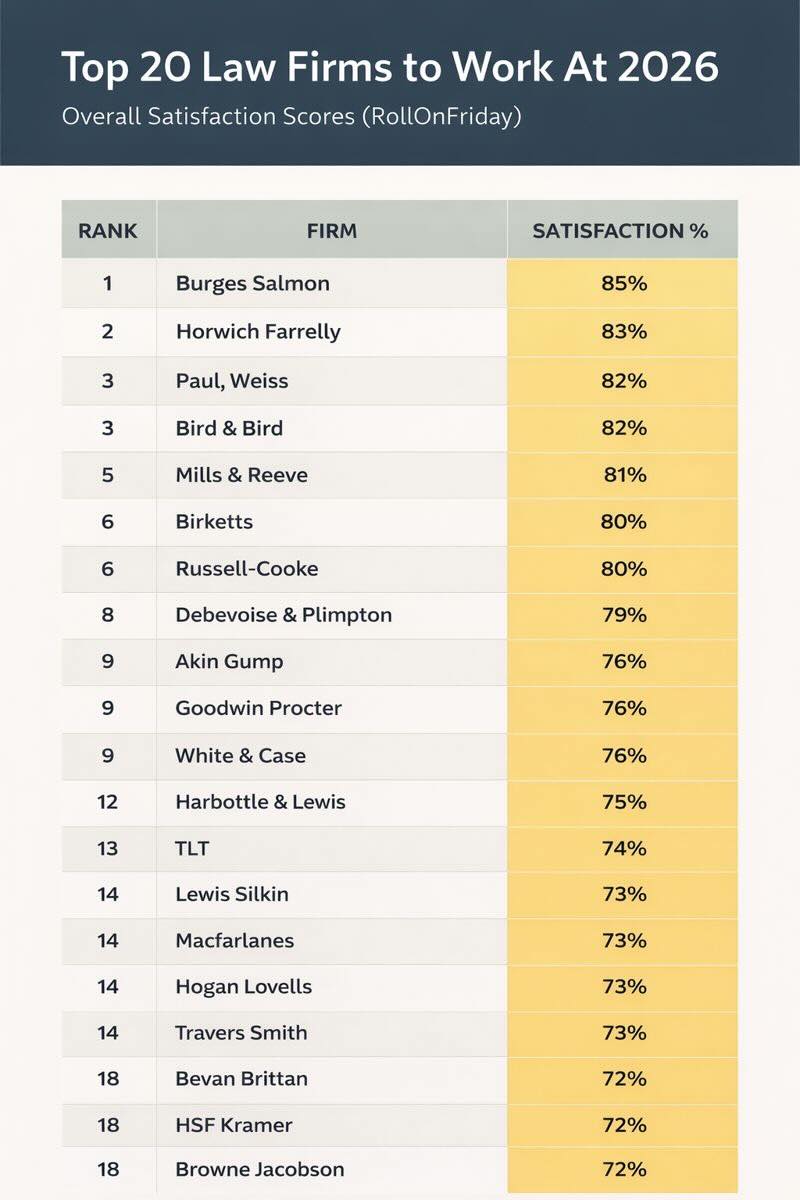
The highest-ranking firms sit firmly within RollOnFriday’s “Very Satisfied” band. Burges Salmon (85%) leads the table, followed by Horwich Farrelly (83%). Joint third place goes to Paul, Weiss (82%) and Bird & Bird (82%), with Mills & Reeve (81%) completing the top five.
All firms in the top 20 recorded satisfaction scores above 70%, signalling consistently positive employee experience across a wide cross-section of the market.
US Firms Perform Strongly
US firms feature prominently among the most satisfied employers. Debevoise & Plimpton placed 8th with a 79% satisfaction score, while White & Case (76%), Goodwin Procter (76%) and Akin Gump (76%) shared 9th place.
Given the intensity traditionally associated with the US firm model, these results stand out. They suggest that while expectations remain high, several US firms are successfully combining premium compensation with a working environment that lawyers rate positively.
Inside the “Very Satisfied” Band
Under RollOnFriday’s methodology, a score of 70%–84% places a firm in the “Very Satisfied” category, allowing for the reality that almost everyone would still welcome higher pay.
In 2026, that benchmark was met by a broad range of firms, including Harbottle & Lewis (75%), TLT (74%), Lewis Silkin (73%), Macfarlanes (73%), Hogan Lovells (73%), Travers Smith (73%), Bevan Brittan (72%), HSF Kramer (72%), Browne Jacobson (72%), Wedlake Bell (72%), Clarke Willmott (71%), DAC Beachcroft (71%), Simpson Thacher & Bartlett (71%), Ropes & Gray (71%), Kirkland & Ellis (71%), Withers (70%), Baker McKenzie (70%), BCLP (70%) and Trowers & Hamlins (70%).
The breadth of firms in this category — spanning US, UK, international and mid-market practices — reinforces a clear takeaway: satisfaction is no longer confined to one firm type or operating model.
Pay Still Matters When It Comes to Retention
Sonder’s own Motivations Report adds important context. More than 50% of lawyers we surveyed identified compensation as a primary driver in their decision to stay at their current firm or consider a move.
Motivations are personal, but the implication is clear: many lawyers are prepared to accept longer hours or greater pressure where the financial upside justifies the trade-off. For some, satisfaction is less about comfort and more about value.
Paul Weiss Making Moves
Against this backdrop, Paul, Weiss ranking joint third overall is particularly notable.
US firms in London typically pay significantly more than their UK counterparts, but that premium comes with longer hours and higher intensity. Entry requirements are also narrower, with hiring largely focused on Magic Circle and Silver Circle backgrounds.
Paul, Weiss’s position suggests that elite pay does not have to come at the expense of culture. The results point to a model where lawyers feel well-rewarded and supported, even at the sharp end of the market.
Top Spot
At the top of the table, Burges Salmon represents a very different proposition. Compensation is materially lower than at US firms, but consistently high satisfaction scores point to a workplace where culture, sustainability and quality of working life are central.
Taken together, the results highlight a simple truth: there is no single “best” firm — only the best fit.
Some lawyers are motivated by maximising earnings and accelerating their careers. Others prioritise balance, fair rewards, support and longevity. The firms performing best are those that are clear about what they offer — and deliver on it consistently.
What This Means for 2026 Hiring
As hiring becomes more competitive, firms can no longer rely on prestige or pay alone. Lawyers are increasingly comparing firms on how compensation is earned, not just how much.
For candidates, understanding personal motivators (financial, cultural or structural), is critical. For firms, clarity of proposition is becoming a competitive advantage.
At Sonder, we use insights like these, alongside real-time market intelligence and candidate feedback, to help lawyers make informed, strategic career decisions. Every move is unique.