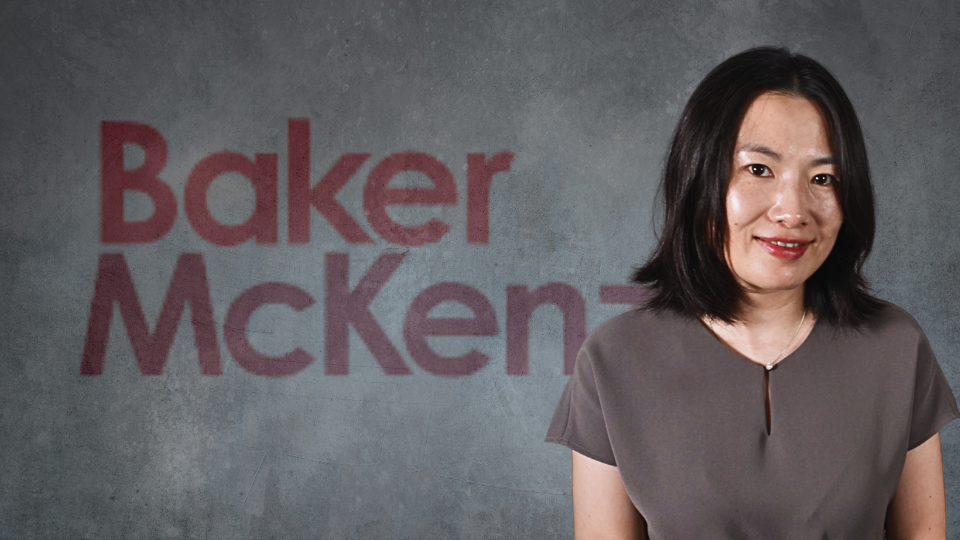
For Lizzie Lu, a career in law has never been confined to one jurisdiction.
Born and raised in China, educated in China and the United States, and now practising as a partner in Baker McKenzie’s Sydney office, Lizzie has built a career across three legal markets. Today, she advises on a broad range of corporate matters, including mergers and acquisitions, capital markets transactions, foreign investment, private equity and corporate governance.
Her background gives her a rare perspective on cross-border work. Qualified in both New South Wales and New York, and fully bilingual in Mandarin and English, Lizzie brings not only technical expertise to complex transactions, but also the cultural fluency often required to get deals across the line.
In the latest episode of Just Briefly, Lizzie joined Kevin Sinnott to discuss her unconventional career journey, the realities of advising across the Asia-Australia corridor, and why the future of legal services may look very different from the traditional hourly billing model.
A career built across China, the US and Australia
Lizzie’s route into law was not entirely planned. Originally majoring in physics, she moved into law at university in China, studying at Fudan University before gaining early experience at King & Wood Mallesons.
From there, she went on to Cornell Law School in the United States, before returning to Shanghai and later making the decision to move to Sydney. At the time, she had never been to Australia.
The opportunity came through Baker McKenzie, where Lizzie joined to support cross-border M&A and IPO work for overseas companies. She arrived in Sydney in October 2014, with no family, no established network and no prior experience living in Australia.
That willingness to step into the unknown has become a defining feature of her career.
As Lizzie explains in the episode, she has never been afraid of entering a new market, taking on a new field, or adapting to a different environment. That international mindset has shaped both the lawyer she has become and the way she advises clients.
Why Baker McKenzie was the right platform
For Lizzie, Baker McKenzie’s global platform has been central to her practice.
Having worked across major legal markets, she values the firm’s ability to operate across jurisdictions in a genuinely integrated way. Many of her matters involve close collaboration with colleagues across Asia and other global offices, particularly where transactions involve multiple regulatory regimes, investor groups and commercial expectations.
She also speaks openly about the importance of culture. Baker McKenzie’s inclusive and multicultural environment has allowed her to build a practice that reflects her own background, particularly as a female Asian partner working at the top end of the corporate market.
In the episode, Lizzie discusses why she returned to Baker McKenzie after a period at another leading firm, and why “boomerang” lawyers can often say a great deal about the strength of a firm’s culture.
Advising across M&A and capital markets
Lizzie advises across both M&A and capital markets, a combination that is more common in Australia than in larger markets such as London, Hong Kong or New York, where lawyers often specialise more narrowly.
For Lizzie, that variety is one of the advantages of practising in Australia.
She explains that IPOs tend to follow a more prescribed process, with a clear roadmap once the transaction is underway. The creative thinking often happens earlier, particularly around structuring. M&A, especially private M&A, can involve more variation, with different structures, commercial dynamics and negotiation points.
Both require pace, precision and client focus. But for Lizzie, they also offer different kinds of satisfaction.
On IPOs, she enjoys getting close to the founders’ stories, understanding how businesses have grown and, in some cases, visiting sites and speaking directly with management teams and employees. M&A, by contrast, can often be more document-driven, with due diligence and structuring taking centre stage.
The human side of cross-border deals
One of the strongest themes in the conversation is the human side of cross-border work.
Lizzie has helped a number of Chinese-founded businesses list on the ASX and has advised extensively across the Asia-Australia corridor. Taking a company from one market into another investor base is rarely just a technical exercise. It requires trust, communication and cultural understanding.
As Lizzie explains, founders from one legal or cultural background may not immediately understand the expectations of another market. For example, once a company is listed, governance obligations change. Directors must consider minority shareholders, regulatory expectations and broader market scrutiny.
At the same time, overseas investors and regulators may bring their own assumptions or concerns.
Lizzie’s ability to operate across Mandarin and English, and across Chinese and Australian business cultures, allows her to bridge that gap. She describes language as only part of the equation. Cultural fluency, tone, communication style and an understanding of what sits behind a client’s decision-making can be just as important.
Where cross-border complexity really appears
From the outside, cross-border transactions can look seamless. Behind the scenes, the reality is often more complicated.
Different jurisdictions bring different timelines, expectations and levels of responsiveness. Local counsel, regulators and government bodies may not always operate at the pace required by a fast-moving transaction.
For the lead adviser, that creates a difficult balancing act. The client expects coordination, clarity and momentum. The lawyers must manage delays, chase responses, smooth over frustrations and keep the transaction moving.
Lizzie notes that this role is not purely legal. It is also about calming clients down, managing expectations and making them feel comfortable through uncertainty.
Foreign investment, geopolitics and Australia’s appeal
The conversation also turns to foreign investment and the changing geopolitical environment.
Lizzie explains that Australia is increasingly seen as a stable jurisdiction for investment, particularly by Asian and Greater China investors. However, that interest sits alongside a more protective regulatory environment, particularly around national security, critical minerals, renewables and sensitive sectors.
Her team works closely with the relevant regulatory landscape, including FIRB considerations, to help clients understand what may be possible, what may require careful structuring and what may be unlikely to gain approval.
That advice often comes at the earliest stage of a matter. Before a client commits time and cost to a transaction, Lizzie and her team help assess the practical likelihood of success.
In today’s market, that commercial judgement is essential.
Hong Kong, Australia and the capital markets opportunity
Lizzie also sees continued opportunity between Hong Kong and Australia, particularly in capital markets.
With Hong Kong IPO activity remaining strong, she believes quality Australian businesses may increasingly look to Hong Kong as a listing venue, accessing Asian and Greater China-based capital.
While sensitive investment areas may continue to face regulatory restrictions, Lizzie sees no reason why the broader Hong Kong-Australia relationship should not continue to grow.
For companies, investors and advisers operating across both markets, that relationship remains one to watch.
What separates a good lawyer from a great one?
For Lizzie, technical excellence is the starting point, not the differentiator.
At top-tier firms, clients expect lawyers to get the law right. That is the baseline. What separates a good lawyer from a great one is whether the advice actually helps the client.
In practical terms, that means not simply sending a long email setting out every rule and complication. It means explaining the issue clearly, identifying the options, helping the client understand what is and is not possible, and finding a way forward where one exists.
Sometimes, that also means telling a client not to spend money on something that cannot be done.
Lizzie describes top-tier legal service as a premium client experience. The quality of the advice matters, but so does how the client feels throughout the process. Great lawyers adapt to different clients, understand how they like to receive advice and make decision-making easier.
AI, efficiency and the future of legal services
Like many leading lawyers, Lizzie is thinking seriously about how AI will reshape legal work.
Her team has started an AI club to explore how tools can reduce process, increase efficiency and deliver better value to clients. She believes junior lawyers entering the profession now face a very different environment from the one she entered.
Drafting remains important. But increasingly, value will come from knowing how to deliver the client’s desired outcome in the most efficient way, how to use tools intelligently, and how to assess whether AI-generated work is right or wrong.
Lizzie also sees a broader shift away from a purely hourly billing model towards a more value-driven approach.
Rather than focusing only on how many hours a task takes, she is interested in how much the work product is worth to the client. In her view, the future of transactional legal services may involve a model where efficiency is rewarded, profit is measured differently, and clients pay for value rather than time alone.
For law firms, that will require support from leadership, changes to incentives and a different way of thinking about performance.
Advice for junior lawyers
When asked what advice she would give to her younger self, Lizzie’s answer is clear: leverage people who are more successful than you, rather than simply putting your head down and working hard every day.
Coming from an Asian cultural background, Lizzie says she naturally believed that long hours and strong work would eventually be recognised. While that did happen in her case, she is clear that recognition is not always guaranteed.
Her advice to junior lawyers is to seek guidance, learn from successful people, and pay attention to wellbeing as well as performance.
In a profession known for long hours and high expectations, that message feels particularly important.
Watch the full episode
Lizzie’s story is one of international experience, cultural fluency and commercial judgement. From China to the US to Australia, her career reflects the increasingly global nature of elite legal work, and the skills lawyers will need as clients, markets and technology continue to evolve.
Watch the full episode of Just Briefly to hear Lizzie Lu discuss her career journey, cross-border transactions, Baker McKenzie’s global platform, AI in legal services, and what it really takes to become a great lawyer.
Watch the full podcast episode here.
Listen to the Just Briefly Podcast on Spotify